
The Empty Chair: Why Africa Can't Wait to Be Invited to the AI Table
By Oluwaseyi Ayodeji, Published on oluwaseyiayodeji.com | Regal Stack Newsletter
I was flying home from Atlanta a few weeks ago, seated next to a woman who worked in conservation for the state of Louisiana. Somewhere over Mississippi, the conversation drifted to her work: protecting endangered species, negotiating cross-border conservation agreements, the slow diplomacy of saving elephants and rhinos from poaching.
Then she said something that had nothing to do with animals and everything to do with what I think about every day.
She told me that in a lot of the international forums where these conservation treaties get negotiated, the countries most affected by the outcome are often the least represented in the room. Decisions get made about them, not with them. By the time the ink dries, the people who have to live with the consequences are handed a policy they had no hand in shaping.
She wasn't talking about AI. She'd probably never read a policy paper on machine learning in her life. But she had just described, with total precision, the exact problem I've spent the last several months writing about.
That's the moment this article is really about. Not conservation. Not a stranger on a plane. The uncomfortable, repeating pattern where the people who live with a problem are the last ones consulted on its solution, and how that same pattern is playing out right now, in real time, in the rooms where the rules for AI are being written.
First, some plain language
Before we go further, let's clear the fog around a few words you'll see a lot in this piece. Not because you need a policy degree to understand AI's future (you don't), but because these words get thrown around vaguely, and vague words let people nod along without understanding what's actually at stake.
Governance is simply: who gets to decide, and who's accountable when those decisions go wrong. When we ask "does Africa have a seat in AI governance," we're really asking: is anyone from Africa in the room when the rules get written, and can they be held to account for the outcomes, or are the rules being written elsewhere and simply handed down?
Policy is a stated intention: the direction a government or institution says it wants to go. A policy on its own is just words on paper. It's a promise, not a guarantee.
Treaty is where policy becomes a binding promise between countries: a formal agreement that's supposed to carry legal weight, not just goodwill.
Ratification is the part almost nobody talks about, and it's the part that matters most. A treaty can be signed with great fanfare and then sit, unratified, for years, meaning it was never actually adopted into a country's own laws. This is the gap where good intentions go to die quietly.
Framework is the scaffolding that turns an intention into a repeatable practice: the actual machinery of implementation, not just the vision statement.
Here's why any of this should matter to you, even if you've never worked a day in policy: AI is not a neutral tool arriving equally to everyone. It is being built, trained, and deployed disproportionately by a small number of companies and countries, and the data, the labor, and increasingly the raw materials powering it are being drawn from places, including much of Africa, that currently have very little say in how the resulting technology gets used, priced, or regulated. If Africa isn't at the table where these rules are made, Africa will simply live under rules made elsewhere. That has happened before. It's happening again, right now, with AI.
Africa has been here before
This is the argument at the center of a paper published in Science by researcher Chinasa Okolo PhD, and it's the reason I wanted to build this piece around her work. Dr Okolo makes a case that's hard to argue with once you see the pattern laid out: Africa's exclusion from today's AI governance conversations isn't new. It's the latest chapter in a much older story.
Go back to 1957. Sixty-seven nations came together for the International Geophysical Year, a landmark moment of global scientific cooperation on everything from polar exploration to earth systems. Not a single independent African nation took part; most were still under colonial rule. Two years later, when the Antarctic Treaty was signed to govern how nations would conduct scientific research on a global scale, the only African country at the table was apartheid South Africa. The rest of the continent had no voice in defining the rules of global science diplomacy; rules that, in various forms, still shape how scientific and technological cooperation happens today.
Africa has spent the decades since trying to close that gap. The Organisation of African Unity, and later the African Union, produced a string of ambitious frameworks: the Lagos Plan of Action, the Abuja Treaty, the Science, Technology and Innovation Strategy for Africa, all aimed at building the continent's technological self-reliance. These weren't empty gestures. But Dr Okolo's paper is honest about what's happened since: agreement on paper has consistently outpaced action on the ground. The 2015 African Union Convention on Cyber Security and Personal Data Protection faced years of slow ratification. The 2024 Continental AI Strategy still isn't fully deployed. The pattern holds: Africa agrees on what needs to happen, and then the machinery to actually make it happen moves too slowly to keep up.
Three things from Dr Okolo's paper struck me as the clearest evidence of why this moment is urgent, not theoretical.
First, the ministerial gap. Around the world, countries serious about shaping AI's future have elevated it to the highest levels of government. The UAE appointed the world's first AI minister back in 2017. France and Canada have followed with AI-specific ministerial roles. On the entire African continent, only one country (Rwanda) has a cabinet-level, standalone AI ministry. Everywhere else, AI policy is squeezed into an already-overloaded ICT or digital economy ministry, competing for attention with a dozen other priorities. That's not a small administrative detail. It's the difference between AI having a dedicated advocate at the highest table in government, or being an afterthought on someone else's agenda.
Second, the diplomatic bottleneck. Kenya's Philip Thigo currently holds the distinction of being the only tech envoy on the entire African continent: one person, effectively representing an entire continent's interests in global conversations about technology's future. That's not a criticism of Thigo. It's a statement about how thin Africa's diplomatic bench is on this issue, at the exact moment those conversations are accelerating.
Third, the ratification gap I mentioned above: the space between signing a treaty and it actually having legal teeth at home. This is where continental ambition keeps quietly stalling.
Dr Okolo's prescription is clear: build dedicated, well-resourced offices for AI diplomacy, train specialized negotiators, and either strengthen the African Union's capacity to coordinate on behalf of the continent, or create an AU-level AI office to do it directly.
I agree with all of this. But I think it's incomplete, and this is where I want to push the conversation further.
The African Union isn't broken. It's overextended.
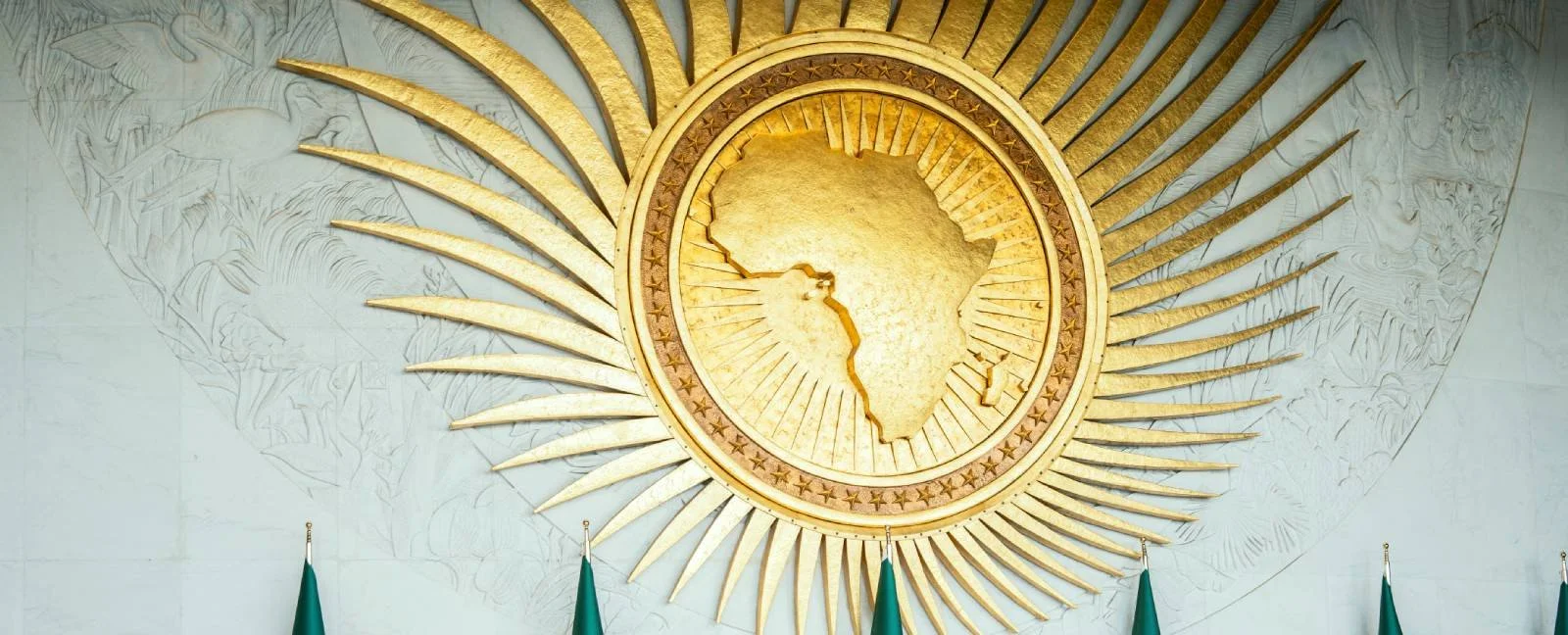
Here's something I've come to believe, drawing on years spent as a program manager, where the single hardest skill isn't technical: it's stakeholder management. Getting fifty-four countries, with genuinely different economies, governments, and priorities, to move in lockstep on anything is one of the most difficult coordination problems in the world. The African Union was a stronger, more decisive institution several years ago than it is today. Some of that is politics. But a lot of it, I suspect, is simply this: consensus-driven, continent-wide coordination is slow by design, and AI is not giving anyone the luxury of time.
Waiting for fifty-four nations to align before Africa shows up at the AI negotiating table isn't caution. It's a forfeit.
So here's my addition to Dr Okolo's argument: while the AU builds out the full infrastructure it needs (and it should, that work matters), Africa should not wait to act. Smaller, faster-moving coalitions of countries that already have real AI infrastructure in place should form now, negotiate now, and secure leverage now, with the explicit intention of folding back into a unified AU position once that infrastructure exists.
This isn't actually a new idea: it's closer to what the Abuja Treaty itself originally envisioned, using regional economic blocs as the fast-moving building blocks of eventual continental integration. The idea was sound in 1994. It simply hasn't been fully realized. AI is the reason to finally realize it.
We already have a live example of what this looks like. Senegal didn't wait for the African Union to build consensus before acting: it became the first African country to join the Global Partnership on Artificial Intelligence (GPAI), securing itself a seat at one of the world's key AI standard-setting bodies while continental infrastructure was still being debated. That's the instinct I'm arguing should become the rule, not the exception.
The criteria for who moves first shouldn't be "biggest economy." It should be AI-readiness: does a country already have a functioning AI strategy or institute, demonstrated diplomatic capacity, and the compute or data infrastructure to back up a seat at the table? By that test, countries like Rwanda, Nigeria, and Egypt look like plausible early movers, not because their economies are the largest, but because they've already built pieces of the infrastructure this moment requires. I want to be clear this is illustrative, not a fixed list: the point is the criteria, not the names.
I'll also name the uncomfortable part of my own proposal, because I think it deserves to be said honestly rather than smoothed over: if a handful of better-resourced countries move ahead as a bloc while the rest of the continent catches up, there's a real risk of recreating, at a continental scale, the exact exclusion Dr Okolo is describing at a global one. Smaller, less-resourced nations could end up being negotiated for by their larger neighbors, the same way Africa has historically been negotiated around by the Global North. That tension doesn't have a clean answer. But naming it honestly is better than pretending speed comes without cost.
Institutions are built by people willing to stay in the room
Wilson White, a Google VP for Global Affairs, wrote recently about a related idea, drawn from a very different context: engineering culture and its comfort operating inside uncertainty. He observed that meaningful progress is rarely built through ideological uniformity; it's built through sustained dialogue across difference, and a willingness to keep showing up at the table even when agreement isn't immediate. It's a fair point, and it applies here too, but I'd add a caveat Africa can't afford to ignore: dialogue only shapes outcomes if you're actually in the room where it's happening. Staying in conversation is necessary. It isn't sufficient if the conversation is happening somewhere you weren't invited.
That's the whole story, really. Not just from a research paper, and not just from a stranger on a flight home from Atlanta. The rules of AI are being written right now, in real time, at a pace that has never once waited for the people it affects most to catch up.
Africa has watched this movie before: in polar science, in ocean exploration, in conservation policy negotiated an ocean away from the animals and the people it claims to protect. The ending doesn't have to repeat itself this time. But it won't change on its own, and it won't change by waiting for permission to be invited in.
The seat has to be taken, not offered.
